
In St. Petersburg, you’ll need one portable toilet per 50 attendees for standard four-hour events, but Florida’s subtropical climate requires a significant adjustment. You must multiply your baseline calculations by 1.25 to account for the 15-20% increase in restroom usage caused by heat and humidity. For events serving alcohol, reduce the ratio to one unit per 35-40 people and ensure that 5-10% of your units meet ADA accessibility requirements. Understanding these climate-specific calculations and regulatory standards will help you maintain proper sanitation compliance throughout your event.
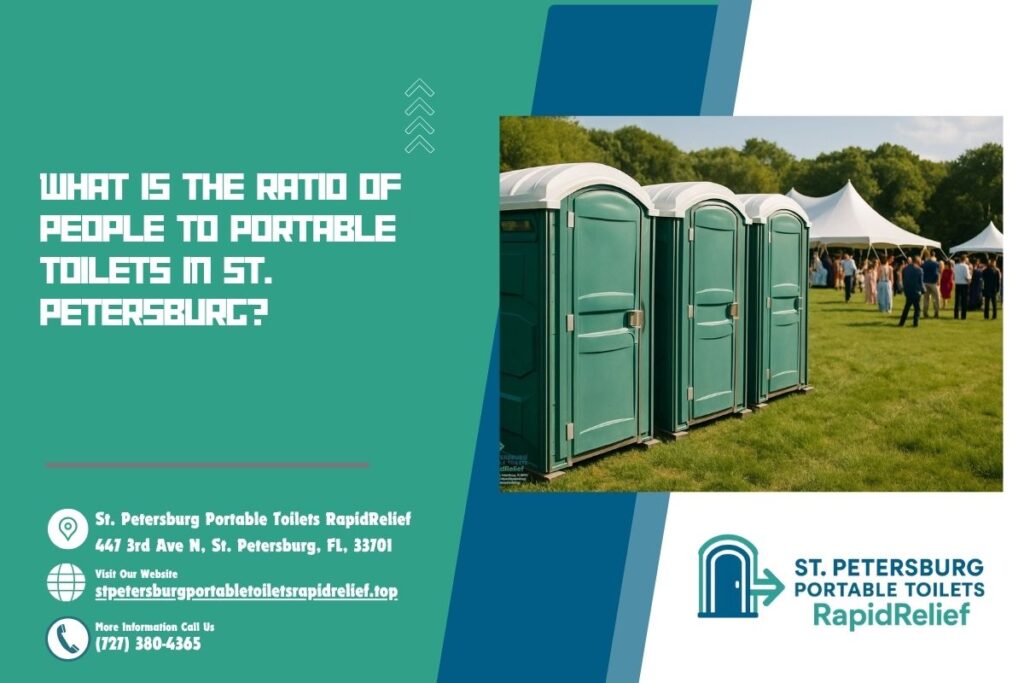
When calculating portable toilet requirements for your St. Petersburg event or project, it is essential to consider several critical factors beyond the basic headcount.
Duration greatly impacts ratios—longer events require more units or frequent servicing. Alcohol consumption increases usage frequency by 30-40%, necessitating supplementary facilities.
Gender distribution matters since women typically need 30% more time per visit. Temperature affects usage patterns, with Florida’s heat driving higher consumption of beverages and subsequent restroom needs.
Event type determines baseline ratios: construction sites follow OSHA standards of 1:10 workers, while festivals require a ratio of 1:50-75 attendees. Food service availability influences requirements, as meals increase the frequency of restroom use.
Accessibility compliance mandates that 5-10% of units must be ADA-compliant. These variables directly affect your ideal portable toilet count.
See also: porta potty rental service in St. Petersburg
Different event categories demand distinct portable toilet ratios based on their operational characteristics and duration profiles.
You’ll need one unit per 50 attendees for events lasting under four hours, but this ratio shifts to one per 35 people for full-day events exceeding eight hours.
Construction sites typically require one toilet for every 10 workers on projects that span multiple months.
Concerts and festivals generate peak usage patterns, necessitating one unit per 75 attendees when alcohol isn’t served, but one per 50 when it’s available.
Wedding receptions typically function well with one luxury unit per 75 guests for events under six hours.
Corporate functions and sporting events follow similar calculations, though you’ll need supplementary facilities for events with restricted bathroom access points or limited existing infrastructure.
Strategic placement of portable toilets directly impacts your required unit quantities, as accessibility constraints can increase demand by 25-40% compared to centrally located facilities.
You’ll need extra units when toilets are positioned more than 300 feet from main activity areas, as attendees won’t travel excessive distances.
Terrain challenges, such as hills, stairs, or uneven ground, require supplementary stations at ground level.
ADA compliance mandates accessible units comprising 5-10% of your total fleet, positioned on firm, level surfaces with clear 60-inch turning radius.
Consider traffic flow patterns—you’ll prevent bottlenecks by distributing units across multiple high-traffic zones rather than clustering them.
St. Petersburg’s outdoor venues often require peripheral placement due to infrastructure limitations, necessitating 15-20% more units than baseline calculations suggest.
Industry standards establish baseline ratios that determine the minimum quantities of portable toilets required, taking into account location-specific adjustments.
OSHA and PSAI guidelines provide frameworks you’ll need for compliance across diverse event types and work environments.
Standard Ratio Guidelines:
You’ll need to calculate based on peak occupancy periods, not average attendance.
St. Petersburg’s climate requires you to factor in increased usage during the summer months.
While baseline ratios establish minimum requirements, ideal portable toilet deployment requires adherence to industry-specific standards that account for occupancy duration, demographic composition, and patterns of facility access.
OSHA recommends one toilet for every 10 workers at construction sites during eight-hour shifts. The Portable Sanitation Association International (PSAI) specifies one unit per 50 attendees for events lasting four hours, increasing to one per 75 when alcohol isn’t served.
You’ll need improved ratios for women-dominant gatherings—approximately 60% of the total units should accommodate female attendees, given their longer usage times.
Special events in St. Petersburg that require extended service periods necessitate extra capacity calculations. Temperature, food service availability, and alcohol consumption patterns directly impact usage frequency.
RapidRelief applies these standards to guarantee your event maintains proper sanitation compliance throughout its duration.
St. Petersburg’s unique climate and event characteristics require adjusted portable toilet ratios beyond standard guidelines.
You’ll need to account for:
You’ll need to multiply base calculations by 1.25 for summer events and maintain supplementary units during tourist season to guarantee adequate capacity and regulatory compliance.
How many portable toilets does your St. Petersburg public event require?
You’ll need one standard unit per 50 attendees for events lasting up to four hours. For events exceeding four hours, increase your ratio to one unit per 40 people.
When alcohol’s served, add 15% more units, as consumption increases restroom usage by approximately 20%.
You’re obligated to provide one ADA-compliant unit for every 10 standard units, as per Florida accessibility regulations.
For events with seating that last over two hours, you can reduce the ratio to one unit per 75 attendees.
Calculate your needs by multiplying the expected attendance by the event duration, then factor in alcohol service and any special requirements.
St. Petersburg Portable Toilets RapidRelief guarantees your event meets all regulatory standards while maintaining attendee comfort.
Large-scale concerts and festivals in St. Petersburg require precise calculations of portable toilets to maintain sanitary conditions and ensure regulatory compliance.
You’ll need to account for higher ratios due to extended event duration, alcohol consumption, and limited alternative facilities.
Standard ratios for these gatherings include:
You should increase these ratios by 40% for events serving alcohol and incorporate dedicated ADA-compliant units at 10% of the total number of units.
St. Petersburg Portable Toilets RapidRelief guarantees your event meets Florida Department of Health requirements while preventing unsanitary conditions.
Sporting events exhibit unique restroom demand patterns that differ significantly from those of concerts, due to concentrated usage during halftimes, intermissions, and pre-game periods.
You’ll need one portable toilet per 50 attendees for events lasting under four hours, but increase this ratio to 1:40 for longer competitions. Factor in alcohol sales, which increase restroom visits by 25-30%.
At outdoor venues like baseball diamonds or soccer fields, place units near concession areas where demand spikes occur. You’ll want separate facilities for players and spectators, with ADA-compliant units comprising 5% of your total inventory.
For multi-day tournaments, schedule mid-event servicing to maintain sanitation standards.
Temperature affects usage patterns—expect higher demand during hot Florida afternoons when attendees consume more beverages.
Construction sites in St. Petersburg are required to have portable toilets in accordance with OSHA regulations and the size of the worker population. You’ll need to follow the standard ratio of one toilet per 10 workers for a regular 40-hour work week.
If your construction project extends beyond the scheduled timeframe, you must increase the number of units in proportion.
Essential considerations for construction site calculations:
You’re responsible for maintaining adequate facilities throughout the lifecycle of your project.
St. Petersburg Portable Toilets, RapidRelief guarantees compliance with local codes while providing reliable service for construction sites throughout the city.
Federal OSHA standards mandate one toilet facility for every 10 workers on job sites, though Florida’s building codes and local St. Petersburg regulations may impose stricter requirements.
You’ll need to calculate your workforce based on peak occupancy, not average headcount. For shifts exceeding eight hours, you’re required to increase facilities proportionally.
Construction sites with 20 workers require a minimum of two units, while those with 50 workers require a minimum of five units. Toilets must be positioned within a five-minute walk of work areas.
If your project employs both male and female workers, you’ll need to provide separate facilities or clearly marked unisex units.
Keep in mind that these ratios represent minimums; adding extra capacity can improve worker satisfaction and reduce wait times during breaks.
Meeting worker-to-toilet ratios represents just the starting point—you must also document your compliance and maintain ongoing adherence to regulations.
St. Petersburg construction sites and event venues must maintain records that demonstrate adequate facilities throughout the project’s duration.
Your compliance obligations include:
Local health departments conduct periodic inspections and can issue citations for non-compliance.
You’ll need immediate access to documentation proving adequate facilities.
St. Petersburg Portable Toilets RapidRelief maintains compliance records for clients, simplifying regulatory requirements while ensuring worker safety.
While standard ratios provide baseline requirements, you must increase the quantities of portable toilets when accommodating individuals with disabilities, pregnant workers, or attendees with medical conditions. Federal ADA regulations require at least 5% of total units to be ADA-compliant, with a minimum of one unit, regardless of the event size.
| Special Need Category | Required Adjustment |
|---|---|
| ADA-Compliant Units | Minimum 5% of total inventory |
| Medical Conditions | Add 1 unit per 50 affected individuals |
| Extended Duration Events | Increase ratio by 25% for events exceeding 4 hours |
St. Petersburg Portable Toilets RapidRelief guarantees your compliance by calculating these adjustments into every quote. You’ll need wider doorways, grab bars, and adequate interior space for wheelchair maneuverability. We’ll assess your specific attendee demographics to determine precise requirements.
ADA-compliant portable toilets measure at least 60 inches wide by 60 inches deep to accommodate a wheelchair turning radius, compared to standard units that measure 44 inches wide.
You’ll need to calculate these units separately from your standard ratio since they serve a protected class under federal law.
The ADA requires one accessible unit for every 20 standard units at most events.
Key specifications include:
St. Petersburg Portable Toilets RapidRelief maintains ADA-certified units that meet ANSI A117.1 accessibility standards, ensuring your event complies with Title III requirements while providing dignified facilities for all attendees.
Beyond the toilet units themselves, Florida’s Chapter 64E-6 Food Hygiene regulations mandate the installation of handwashing stations when portable toilets are used at events with food service or handling.
You’ll need one handwashing station per portable toilet at food-related gatherings, ensuring compliance with state sanitation requirements.
Each handwashing station must provide clean water, soap, and paper towels or air-drying capability. The standard ratio is 1:1 with toilet units for food events; however, high-traffic situations may require additional stations.
You should position handwashing stations within 200 feet of food preparation areas and adjacent to restroom facilities.
For events lasting over four hours, you’ll need attendants to maintain supplies and cleanliness.
St. Petersburg Portable Toilets RapidRelief offers standalone handwashing stations and combination units, helping you meet regulatory standards while protecting public health.
When planning portable toilet rentals for your St. Petersburg event, you’ll need to calculate capacity requirements based on established OSHA and IAPMO guidelines.
Start with the standard 1:50 ratio (one unit per fifty people), then adjust for these critical factors:
St. Petersburg Portable Toilets RapidRelief provides compliant configurations that meet Florida Department of Health sanitation standards while ensuring adequate service levels.
Accurate crowd size projections form the foundation of compliant portable toilet deployment, requiring you to analyze multiple data sources rather than relying solely on registration numbers.
You’ll need to account for walk-up attendees, vendor staff, and event personnel when calculating total capacity requirements. Event duration directly impacts service frequency—a four-hour gathering requires different provisions than an eight-hour festival.
You must consider peak usage periods, typically occurring during scheduled breaks, meal times, and headliner performances. Factor in 15-20% buffer capacity to accommodate unexpected attendance increases and prevent queue formation that violates Florida health codes.
St. Petersburg Portable Toilets RapidRelief assists you with precise calculations based on historical attendance data, venue characteristics, and seasonal tourism patterns to guarantee regulatory compliance throughout your event.
Local rental providers maintain detailed compliance records that you’ll need to verify before finalizing any portable toilet contract for your St. Petersburg event. These documents demonstrate adherence to Florida Department of Health regulations and proper waste disposal protocols.
When selecting a rental provider, confirm they offer:
Professional providers, such as RapidRelief, calculate ratios using industry formulas while accounting for St. Petersburg’s climate conditions, which influence usage patterns and maintenance intervals throughout your event.
You should service portable toilets every 2-3 days during multi-day events, though high-traffic situations may require daily servicing. We’ll calculate your specific needs based on attendance numbers, event duration, and usage patterns to maintain regulatory compliance.
You’ll find that standard portable toilet rentals in St. Petersburg typically range from $85 to $150 per unit for weekend events, while ADA-compliant units cost between $165 and $225. Multi-day rentals and servicing requirements significantly impact your total project costs.
Yes, you’ll find emergency portable toilet delivery available within 24 hours in St. Petersburg. RapidRelief maintains ready-to-deploy units that meet Florida sanitation codes, ensuring proper waste capacity ratios for your urgent event or construction site needs.
Yes, your rental includes initial supplies of toilet paper and hand sanitizer. RapidRelief guarantees each unit meets health code requirements upon delivery. For extended events, you’ll need to schedule servicing intervals based on calculated usage rates to maintain compliance.
If your portable toilet reaches capacity during an event, you’ll need emergency service. Contact your rental provider immediately—they’ll dispatch a pump truck to service the unit, restoring functionality within regulatory compliance standards for your event.



© 2026 St. Petersburg Portable Toilets RapidRelief. All Rights Reserved.